Materials & process ·
Why Brass Hardware Prices Vary: Forging, Stamping and Lost-Wax Casting
Two parts can both be described as solid brass, look similar in a photograph and still have very different cost structures.
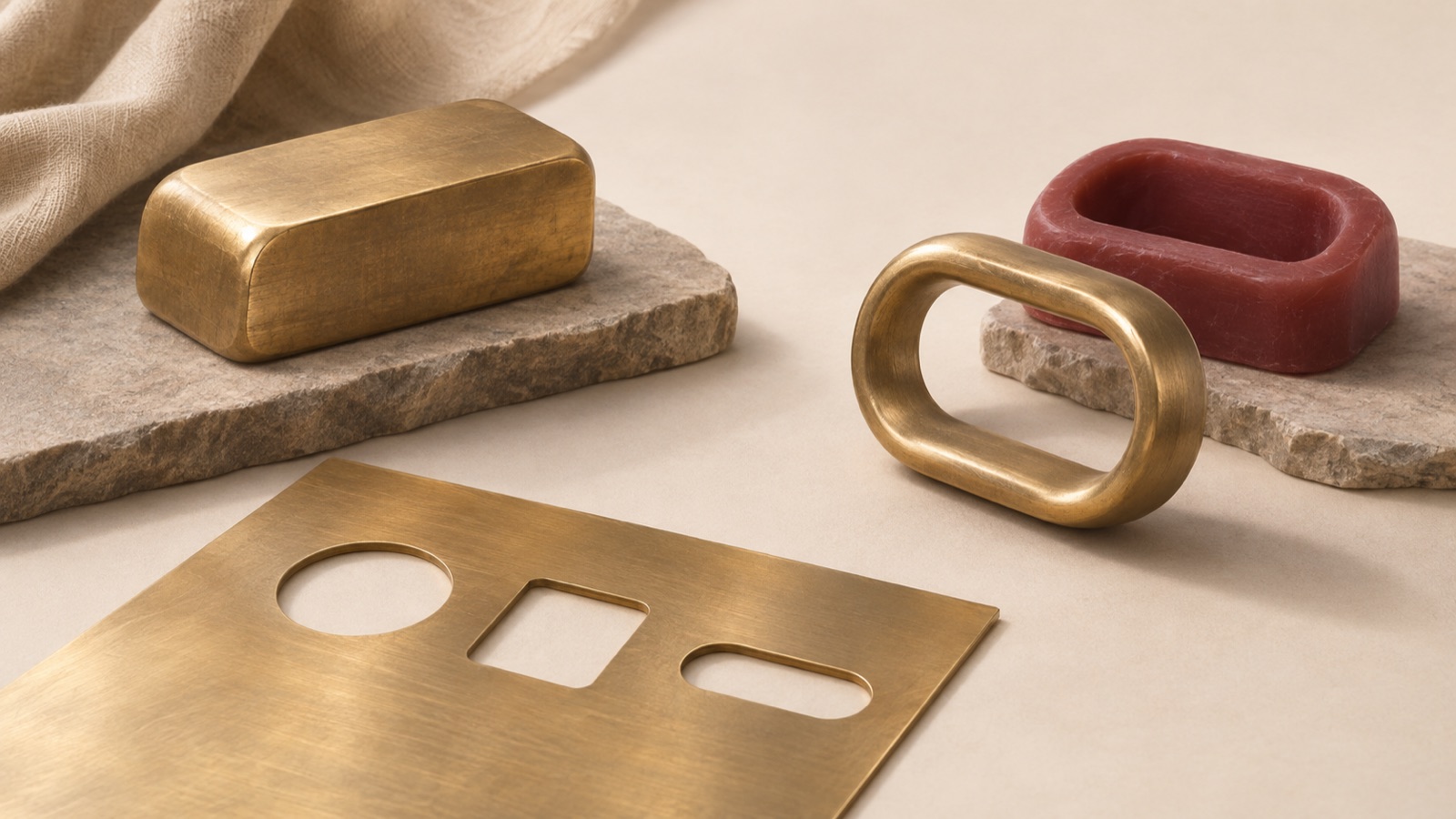
Material grade and finished weight matter, but they are only the beginning. Geometry, production method, tooling investment, order quantity, machining, surface finishing, inspection, packaging and freight all shape the final quote. A gold-coloured finish is not proof of solid brass, and “solid brass” describes the material—not how the part was made.
Forging: pressure, heat and secondary work
In the route usually relevant to substantial brass hardware, a cut billet is heated and shaped under compressive force in dies. This is hot forging, not pouring molten metal into a mould. Tooling must be made, excess flash may need trimming, and holes, threads or close-tolerance faces may still require machining. Those steps, along with billet weight and material yield, belong in the cost discussion.
Tooling is a fixed investment that can be spread across repeat production, so expected lifetime volume matters as much as the first order. Forging is not automatically the cheapest option, nor should buyers assume every forged part will outperform every casting. Design, alloy, process control and application testing determine actual performance. The useful question is whether the geometry and requirements justify this route.
Stamping: forming sheet or strip
Metal stamping starts with sheet or strip and uses dies to cut, punch and bend it. In progressive-die stamping, the strip advances through stations that perform successive operations. This is different from the loose industry use of “hot stamping” to describe hot-press forging.
Once the tool is running, fast, repeatable cycles can reduce unit processing cost across suitable volumes. The trade-off is the upfront die and setup investment, and the design must suit sheet-based forming. A thin stamped component and a thick, three-dimensional casting are not equivalent specifications simply because their front views look alike. Compare wall or sheet thickness, weight, back construction and assembly details.
Lost-wax casting: detail through an expendable pattern
Investment casting, often called lost-wax casting, begins with a wax pattern. Patterns are assembled, coated with refractory material to build a shell, and removed by heating. Molten metal fills the resulting cavity; after cooling, the shell is removed, parts are cut from the feeding system and finishing work follows. This route can reproduce complex three-dimensional contours and fine surface detail.
“Lost wax” does not mean “no tooling.” Production wax patterns are often injected into a metal die, although printed or other pattern approaches may be considered for development work. Each casting still consumes a pattern, while shell building, pouring, cutoff and finishing remain recurring work. Whether a small order is economical depends on the available pattern method, existing tooling, geometry and supplier quote—not on a universal minimum.
Why process names do not settle the quote
A buyer may be offered a “steel mould” or a “wax mould” as if these were mutually exclusive production categories. They are not: a metal die can make the wax patterns used in investment casting. Ask the supplier to describe the complete route from raw material or wax pattern to finished component. That answer reveals which tooling is reusable, which steps recur for every piece, and where dimensional or cosmetic variation may arise.
A better RFQ checklist
For comparable quotations, provide the alloy requirement; drawing dimensions and tolerances; strap or belt inside width; target weight; the complete component set, including pin or roller; finish reference or approved sample; order quantity and forecast; tooling ownership and what the tooling charge includes; post-processing and inspection expectations; packaging; and required delivery date. Ask the supplier to identify the proposed process and any design changes it requires.
The right choice is the process that fits the design, performance needs and realistic ordering plan—not simply the lowest headline unit price.
Discuss your project
Start with the design and the ordering plan.
Send the design, size, finish and expected quantity to JOVA to discuss a suitable production option.
Contact JOVA →